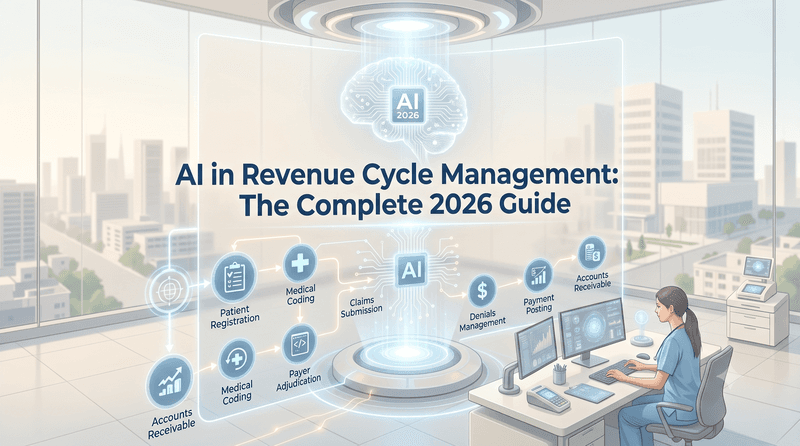


Revenue cycle management has quietly become one of the most crowded categories in healthcare AI. Nearly every vendor in medical billing now describes itself as "AI-powered," which makes the term almost useless on its own. Some of that is real predictive denial models, automated coding, and eligibility checks that used to take a phone call now happen in seconds. Some of it is a rules-based system from five years ago with a new label. This guide is meant to help you tell the difference, and to give you a sense of where the category actually is heading into the rest of 2026.
What "AI in RCM" Actually Covers
Revenue cycle management spans the entire financial journey of a patient encounter including registration, eligibility verification, coding, claims submission, denial handling, and final collections. AI has touched nearly every step of that chain, but unevenly. A few areas are genuinely mature:
- Predictive denial management - flagging claims likely to be denied before they're submitted, based on payer-specific patterns
- Automated medical coding - suggesting or assigning CPT/ICD codes from clinical documentation, reducing manual coder workload
- Eligibility and benefit verification - checking coverage in real time instead of over the phone
- Underpayment detection - comparing what was paid against contract terms to catch systematic underpayments
Other areas like fully autonomous appeals writing or end-to-end agentic claim resolution are earlier stage. Vendors are actively building toward this, but "AI handles it end-to-end with no human review" claims are still worth treating with some skepticism regardless of the category.
Why Practices Are Adopting This Now
The push isn't abstract. Industry research (Black Book Research) has found that more than three-quarters of U.S. healthcare organizations now report using AI somewhere in their revenue cycle operations, and the shift has accelerated as denial rates climb and staffing shortages make manual claim review harder to scale. For a practice or health system, the appeal is straightforward: fewer denials, faster reimbursement, and less staff time spent on repetitive administrative work rather than patient-facing tasks.
Where the Category Stands in 2026
The vendor landscape now roughly splits into a few tiers, and understanding which tier a vendor sits in matters more than any single feature comparison:
Large, established RCM platforms like Waystar and R1 RCM have layered AI and predictive analytics onto revenue cycle infrastructure that was already handling billions of dollars in claims before "AI-native" was a category. Waystar in particular was recognized as the top performer in a major 2026 industry benchmark evaluating agentic and generative AI capabilities across roughly twenty vendors, which is a useful data point if you want third-party validation rather than vendor marketing.
AI-native platforms built more recently, such as AKASA and Adonis, market themselves specifically on having been built around AI and predictive models from the start rather than retrofitted onto older systems. This can mean tighter, more purpose-built automation but it also means a shorter track record at scale, which is worth weighing against the pitch.
Specialty and workflow-specific tools, like CodaMetrix for coding automation orMD Clarity for underpayment and contract recovery, focus narrowly on one part of the revenue cycle rather than trying to cover the whole thing. These are often a better fit for a practice with one specific, painful bottleneck rather than a system-wide overhaul.
Integrated EHR-plus-RCM platforms, such as athenahealth, bundle clinical documentation and billing into a single system, which reduces handoff errors between clinical and financial workflows at the cost of being tied to that vendor's broader ecosystem.
None of this means bigger or newer is automatically better for your practice. It means the right evaluation question isn't "does it use AI" but "which part of my revenue cycle is actually the bottleneck, and which tier of vendor is built to solve that specific problem."
What to Actually Evaluate
Vendor pitch decks in this category tend to emphasize the same handful of metrics. Here's what's worth pushing past the marketing to verify:
- First-pass claim acceptance rate - and specifically, whether the vendor's stated number reflects your specialty and payer mix, not their broadest average across all customers
- Days in accounts receivable, before and after, from a reference customer similar in size to your practice
- Which payers it actually integrates with - a strong average across all payers is meaningless if the two payers making up 60% of your volume aren't well supported
- How denials and appeals are handled when they need a human - every serious vendor still has a human-in-the-loop step somewhere; ask what that looks like
- Implementation timeline and who does the data migration work - this is where a lot of the real cost of "switching to AI" actually lives, and it's often underrepresented in initial sales conversations
Asking for a reference customer close to your own size and specialty, rather than relying on the vendor's published case studies, tends to surface the most honest picture.
A Reasonable Way to Start
You don't need to overhaul your entire revenue cycle at once. Most practices see the clearest, fastest return by starting with whichever single bottleneck is costing the most time or money today - denial rates, coding backlog, or eligibility verification calls rather than signing a full-platform contract on the promise of comprehensive transformation. Once that narrower tool proves out, expanding scope is a much lower-risk decision than starting broad.
Compare AI tools by sub-category — medical coding, denial management, benefit verification, and full-service RCM — in our Revenue Cycle Management directory.
FAQ
Is AI actually reducing claim denials, or is that mostly marketing? Predictive denial flagging , catching documentation gaps before submission has real, measurable evidence behind it. Full autonomous appeals handling is earlier-stage and varies more by vendor.
Do I need a full AI RCM platform, or can I start smaller? Most practices get faster, lower-risk returns starting with a single bottleneck (coding, denials, or eligibility) rather than a full-platform switch.
How do I compare vendors beyond their marketing claims? Ask for a reference customer similar in size and specialty to yours, and get their real first-pass acceptance rate and days-in-AR numbers rather than the vendor's broadest published average.
Top comments (0)
Please login or create an account to leave a comment.