

Prior authorization consumes an estimated 13 hours of staff time per physician every week, and CMS has put the annual administrative cost at roughly $34,000 per provider. It's consistently ranked as one of the most disliked parts of running a practice, for a simple reason: it's rarely clinically complicated, just slow, manual, and full of small ways to get rejected due to a missing code, a form sent through the wrong channel, documentation a payer says wasn't included even when it was.
AI prior authorization software is built to remove exactly that friction. It doesn't make coverage decisions payers still do that, but it automates the mechanical work around a request: pulling documentation, matching it to payer-specific rules, submitting it correctly the first time, and flagging gaps before they turn into denials.
Why This Is Becoming Urgent, Not Optional
This category isn't just a nice-to-have efficiency play anymore. CMS-0057-F, a federal rule finalized under the CMS Interoperability and Prior Authorization framework, requires impacted payers to support electronic prior authorization with defined turnaround times, starting with compliance deadlines that include January 2027. Payers are actively building toward that deadline, and provider-side tools are adapting alongside them. If your practice is still handling prior auth manually, this deadline is a reasonable forcing function to evaluate automation now rather than later, since payer workflows on the other end of the process are about to change either way.
How It Actually Works
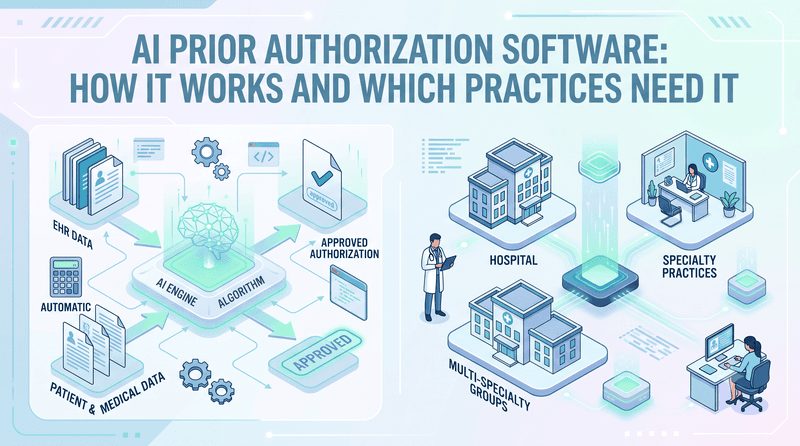
Most AI prior authorization tools follow a similar sequence:
- Pull clinical data automatically from the EHR when an order requiring authorization is placed, instead of requiring staff to re-enter it manually
- Match the request against payer-specific medical necessity criteria, often using natural language processing to interpret clinical notes the way a human reviewer would
- Flag missing or weak documentation before submission, rather than waiting for a denial to discover a gap
- Submit electronically through the correct payer channel and track status automatically
Some newer platforms go further, using AI to determine whether a given service actually requires prior authorization in the first place, payer rules change often enough that keeping up manually is close to a part-time job on its own.
What It Doesn't Replace
No credible vendor in this category claims full automation with zero human involvement. Complex cases, appeals, and genuine medical necessity disputes still require staff or clinician review. The realistic value proposition is that routine, high-volume authorizations get handled automatically, freeing staff time for the cases that actually need judgment not that prior authorization disappears as a workflow entirely.
The Vendor Landscape, Broadly
Rather than a ranked list, it's more useful to understand the categories these tools fall into, since the right fit depends heavily on what you're already running:
RCM-platform-embedded tools - Waystar's Authorization Manager is built as a layer on top of its broader revenue cycle platform, so practices already using Waystar for claims and eligibility get prior auth folded into the same workflow rather than a separate system to manage.
Payer-facing, standards-focused platforms - Availity AuthAI is built specifically around CMS-0057-F compliance and transparent, auditable decision logic, which matters most if you're evaluating a tool through the lens of the coming regulatory deadline.
Multi-payer, policy-automation platforms - Myndshft and Cohere Health focus on automatically keeping up with payer policy changes across both medical and pharmacy authorizations, which can matter a lot if your specialty deals with a wide, shifting payer mix.
MSO and multi-practice platforms - tools like Honey Health and Linear Health are built for organizations managing prior auth across multiple practice sites and EHRs at once, rather than a single-location deployment.
Enterprise revenue cycle suites - Experian Health and Innovaccer offer prior auth automation as part of a broader patient access or unified data platform, which suits larger organizations already consolidating revenue cycle infrastructure.
The honest takeaway: bigger platform, more integrated, and more expensive isn't automatically the right fit for a smaller practice with a narrower need. A single-purpose tool that does prior auth well is often the better starting point than a full RCM suite bought for one feature.
Which Practices Actually Need This
This tends to deliver the clearest return for:
- High-authorization-volume specialties - cardiology, oncology, imaging-heavy practices, and anything involving frequent high-cost procedures or specialty medications
- Practices where staff time is the real constraint - if the alternative to automating this is hiring another full-time person just to manage authorizations, the math usually favors the software
- Groups seeing denial rates climb, since upfront documentation-gap flagging tends to have an outsized effect on reducing avoidable denials specifically
A low-volume practice with occasional authorization needs may not see enough return to justify a dedicated platform, that's a legitimate outcome of an honest evaluation, not a reason to avoid the category altogether.
What to Verify Before You Buy
- Which payers it actually integrates with. A strong average across all payers is meaningless if the two or three payers making up most of your volume aren't well supported.
- What happens with complex or urgent cases. Ask specifically what the escalation path looks like. This is where some tools quietly fall back to a fully manual process without saying so upfront.
- Whether pricing is public or requires a sales conversation, and if it's the latter, ask why. Vendors serious about small and mid-size practices tend to be more transparent about cost.
- Real accuracy and turnaround data from a comparable customer, not the vendor's broadest published average across all customer sizes and specialties.
- How CMS-0057-F compliance is being handled, since this affects how payers on the other end of the transaction will behave starting in 2027 regardless of which vendor you choose.
Bottom Line
AI prior authorization software won't eliminate the process, and any vendor claiming zero human involvement is worth being skeptical of. What it reliably does is remove the parts that were slow because of logistics hold times, resubmission cycles, and documentation gaps rather than clinical necessity. Combined with a regulatory deadline that's pushing payers toward electronic processing anyway, this is a reasonable category to evaluate now rather than waiting until the deadline forces the decision.
Compare AI tools in our Revenue Cycle Management category on Doxiverse.
FAQ
Does AI prior authorization software guarantee approval? No. It automates documentation, payer-rule matching, and submission. The payer still makes the coverage decision. Complex cases still typically require human review.
What is CMS-0057-F and why does it matter for prior authorization? It's a federal interoperability rule requiring impacted payers to support electronic prior authorization with defined turnaround times, with compliance deadlines including January 2027. It's accelerating automation on both the payer and provider sides.
Is a dedicated AI prior auth platform worth it for a small practice? It depends on authorization volume. High-volume or high-denial specialties tend to see the fastest return; low-volume practices may get more value from a narrower, lower-cost tool than a full enterprise platform.
Top comments (0)
Please login or create an account to leave a comment.