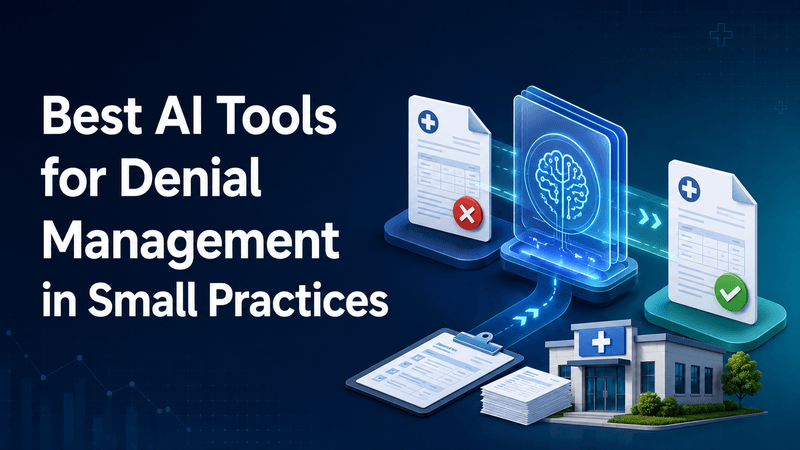


Most "best AI denial management software" content published right now is written for hospitals and large health systems managing tens of thousands of claims a month. The platforms are frequently priced, staffed, and built around that scale. A five-physician independent practice has a genuinely different problem: fewer claims overall, less dedicated RCM staff, and no appetite for an enterprise implementation that takes months and a dedicated project team. This is a guide to that specific situation, not a scaled-down version of the hospital conversation.
Why This Matters More Than It Used To
Claim denials represent one of the largest sources of preventable revenue loss in healthcare, and industry estimates put the scale of the problem in the hundreds of billions of dollars annually across the system - much of it tied to process defects rather than genuine medical necessity disputes. For a small practice operating on thin margins with limited administrative headcount, denials aren't just an efficiency problem; a rising denial rate can directly threaten cash flow in a way it doesn't for a large system with reserves and a full RCM department to absorb the impact.
What "Built for Small Practices" Actually Means
When evaluating this category specifically for a smaller practice, a few things matter more than they would at hospital scale:
- Bundled versus point solution. A small practice often doesn't want a separate denial management tool bolted onto an existing EHR and billing system - the integration overhead alone can outweigh the benefit. Platforms that fold denial management directly into an existing EHR/billing/practice management suite tend to be a better fit than a specialized enterprise analytics platform.
- Transparent, predictable pricing. Enterprise denial platforms often price by claim volume, percentage of recovered revenue, or require a sales conversation to get a number at all. A small practice benefits from flat or predictable subscription pricing it can actually budget against.
- Minimal implementation lift. A multi-month rollout with a dedicated project manager makes sense for a 500-bed hospital. It doesn't for a practice where the office manager is also doing scheduling and patient calls.
- Staff-light operation. The tool should reduce the workload of existing front-desk and billing staff, not require hiring a new specialist to run it.
Where Smaller Practices Tend to Fit in the Vendor Landscape
Rather than a ranked list, here's roughly how the landscape splits by fit:
Bundled EHR-and-billing platforms - tools like Tebra, AdvancedMD, and CollaborateMD combine EHR, billing, and denial management into one system specifically marketed toward smaller and independent practices, aiming to reduce the number of separate vendors and integrations a small office has to manage.
Specialty EHR suites with embedded denial tools - platforms like CureMD and Nextech bundle claim scrubbing, real-time eligibility, and denial dashboards directly into a specialty-focused EHR, which suits a practice that wants one vendor covering both clinical and financial workflows rather than stitching pieces together.
Focused, subscription-priced denial-and-underpayment tools - some newer platforms are built specifically to serve smaller organizations that don't have the claim volume to justify an enterprise analytics contract, prioritizing a clear worklist over full autonomous appeal generation.
Enterprise platforms - tools like Waystar, FinThrive, and Innovaccer are built for hospitals and large multi-site health systems. They're not a poor fit because they don't work - they're a poor fit because their pricing, implementation complexity, and feature depth are built for a scale most small practices don't operate at, and paying for that scale doesn't return proportional value.
Being Skeptical of the Numbers You'll See
A lot of vendor content in this space cites strong headline numbers - 20–30% reductions in first-pass denials, 75%+ appeal success rates, fully automated resolution at "95%+ accuracy." Some of these figures are genuinely supported by case studies; others are the vendor's own best-case example presented as a typical outcome. Two things are worth doing before any of these numbers factor into a decision: ask what population and specialty mix the figure is based on, and ask for a reference customer close to your own size, not the vendor's flagship enterprise account.
What to Verify Before You Buy
- Does it integrate with your existing EHR and clearinghouse, or does adopting it mean changing other systems too?
- What's the actual monthly or per-claim cost, including any setup fee, and is pricing published or only available after a sales call?
- Does it prevent denials upfront (checking claims before submission) or only help you recover them after the fact? Prevention tends to matter more for a smaller practice that can't absorb the cash-flow lag of a slow appeals cycle.
- How much manual work remains? Ask specifically what a staff member's day looks like using the tool, not just what the dashboard shows.
- What's the contract length and cancellation policy? Smaller practices generally benefit from shorter commitments while evaluating fit.
Bottom Line
The "best" denial management tool for a small practice usually isn't the one at the top of a hospital-focused ranking - it's the one that integrates cleanly with what you already run, prices predictably, and reduces work for the staff you already have rather than adding a new system to manage. Prevention-focused, bundled tools tend to be the more realistic starting point than enterprise analytics platforms built for a very different scale of operation.
Compare RCM and denial management tools in our Revenue Cycle Management category on Doxiverse.
FAQ
Do small practices need a dedicated AI denial management tool? It depends on denial volume and current administrative capacity. Practices seeing a rising denial rate or spending significant staff time on appeals tend to see the clearest return; very low-denial practices may not need a dedicated tool yet.
Is enterprise denial management software worth it for a small practice? Usually not. Enterprise platforms are priced and built for hospital-scale claim volume, and a small practice typically pays for capability it can't use rather than getting proportional value.
Should a small practice prioritize denial prevention or denial recovery tools? Prevention - catching issues before submission - generally matters more for smaller practices, since it avoids the cash-flow lag of a slow appeals cycle that a larger organization can absorb more easily.
Top comments (0)
Please login or create an account to leave a comment.