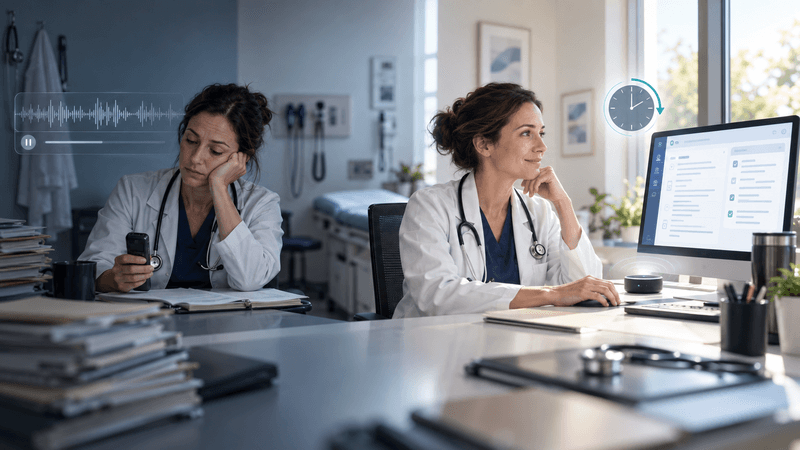


Dictation has been the default alternative to typing a note for decades, and it's not going anywhere for every use case. Ambient AI scribes are newer, more heavily marketed, and often positioned as dictation's replacement. The honest answer to which one saves more time is: it depends on the workflow, the specialty, and based on the research so far - sometimes the individual physician. Here's what the comparison actually looks like once you set marketing claims aside.
How the Two Actually Differ
Traditional dictation converts spoken words into text, generally after the visit. The physician talks through the encounter including history, exam findings, assessment, plan and either a transcription service or software converts it into a document. It's a straightforward conversion: what's said becomes text, largely unedited for structure.
Ambient AI scribes listen to the live conversation between physician and patient during the visit itself, then generate a structured clinical note - organized into sections like history of present illness, assessment, and plan - without the physician needing to dictate anything separately afterward. The physician's job shifts from generating the note to reviewing and editing one that already exists in something close to final form.
That structural difference is the whole case for AI scribes: dictation requires a separate documentation step after the visit ends; ambient scribing aims to have most of the note already drafted by the time the visit is over.
What the Actual Research Shows
This is where it's worth being more careful than most comparison articles are.
The evidence is genuinely mixed, not uniformly positive. A pilot quality-improvement study in palliative medicine comparing an ambient AI scribe directly against standard dictation found a split result: one resident physician saw a statistically significant reduction in documentation time, while a second resident saw essentially no improvement at all, despite using the same tool in the same setting. The study's authors were explicit that the sample was too small to draw firm conclusions, but the split result itself is informative that it suggests individual workflow and adaptation matter as much as the tool.
Larger studies show the same pattern of inconsistency. A longitudinal quasi-experimental study tracking ambient scribe use across primary care clinicians over several months noted that existing research on documentation time savings is genuinely contested in the literature - some studies report real reductions in note-writing time, while others report no or only marginal savings. This isn't a case of one bad study being an outlier; it reflects real variation across the research base.
Physician-reported experience is more consistently positive than objective time measurements. Separate research, including a Stanford study of a small group of physicians, found high rates of physicians reporting the technology was easy to use and expedited note-taking - even in situations where objective time-in-note didn't necessarily drop by the same margin. That gap between subjective relief and objective time savings is worth taking seriously in both directions: it doesn't mean the tools don't help, but it does mean "physicians love it" and "it objectively saves X minutes per note" are two different claims, and vendor marketing sometimes blurs them together.
"Pajama time" is where the more consistent gains show up. Even where total documentation time doesn't drop dramatically, several studies and health-system reports point to a shift in when documentation happens - less note-writing pushed into evenings and after-hours, since the bulk of the note exists closer to real time. Given that after-hours EHR use is one of the more consistently cited drivers of burnout, this timing shift may matter more for physician wellbeing than the raw minutes-saved number that gets marketed.
Where Dictation Still Wins
Ambient scribing isn't a universal upgrade. It depends on there being a conversation to listen to in the first place. Specialties like radiology and pathology, where a clinician is describing findings from an image or a slide rather than talking with a patient, don't have an "encounter" for an ambient tool to capture - dictation remains the natural fit there, and isn't being meaningfully displaced by ambient scribes in that context.
Dictation can also still make sense for physicians who prefer talking through their own clinical reasoning explicitly, rather than reviewing an AI's interpretation of a conversation - some physicians report finding it faster to compose a note in their own words than to edit someone else's (or something else's) draft, even a good one.
How to Actually Decide
Rather than assuming an ambient scribe will automatically save time because it's newer, it's worth running a real trial with a handful of physicians across a normal, unfiltered week, not a single easy day and measuring actual note-completion time and after-hours EHR activity before and after. Given how inconsistent the published research is, your own practice's result may not match anyone else's published number, and that's a reasonable thing to plan for rather than be surprised by.
Compare ambient AI scribes in our Clinical Documentation category on Doxiverse.
FAQ
Do AI scribes always save more time than dictation? Not consistently, based on current research. Some studies show meaningful time savings; others show little to no difference, and results can vary by individual physician even within the same study.
Is dictation becoming obsolete? No. It remains the standard for specialties like radiology and pathology, where there's no patient conversation for an ambient tool to capture, and some physicians still prefer composing notes in their own words.
What's the most consistent benefit of ambient AI scribes shown in research so far? A shift in when documentation happens - less note-writing pushed into evenings and after-hours - appears more consistently across studies than raw total time saved.
Top comments (0)
Please login or create an account to leave a comment.